The Biweekly $1,000 Savings Challenge (No More Weird Weekly Math)
Most savings challenges assume you get paid every week. Most people don’t. If your paycheck lands every other Friday, trying to follow a 52-week chart means doing mental math every single time just to figure out which “week” you’re actually on. It gets confusing fast, and confusing money systems are the ones people quit.

So here’s a version built around 26 paydays instead of 52 weeks. Same idea, same $1,000 goal, but it actually lines up with how you get paid.
How it works
Every time you get paid, you set aside a specific amount and check it off. The amounts start small and grow a little each time, so the early paychecks are easy and you build momentum before the bigger deposits show up. By your last payday of the year, you’ll have hit $1,000.
You don’t need a big income change to make this work. You just need to treat that transfer like a bill that has to get paid, right when your paycheck lands.
Grab the chart
I made a printable version so you don’t have to do any of the math yourself. It lays out all 26 paydays, the amount to save each time, and a running total so you can watch the number climb.
[DOWNLOAD THE FREE BIWEEKLY $1,000 SAVINGS CHALLENGE PRINTABLE HERE]
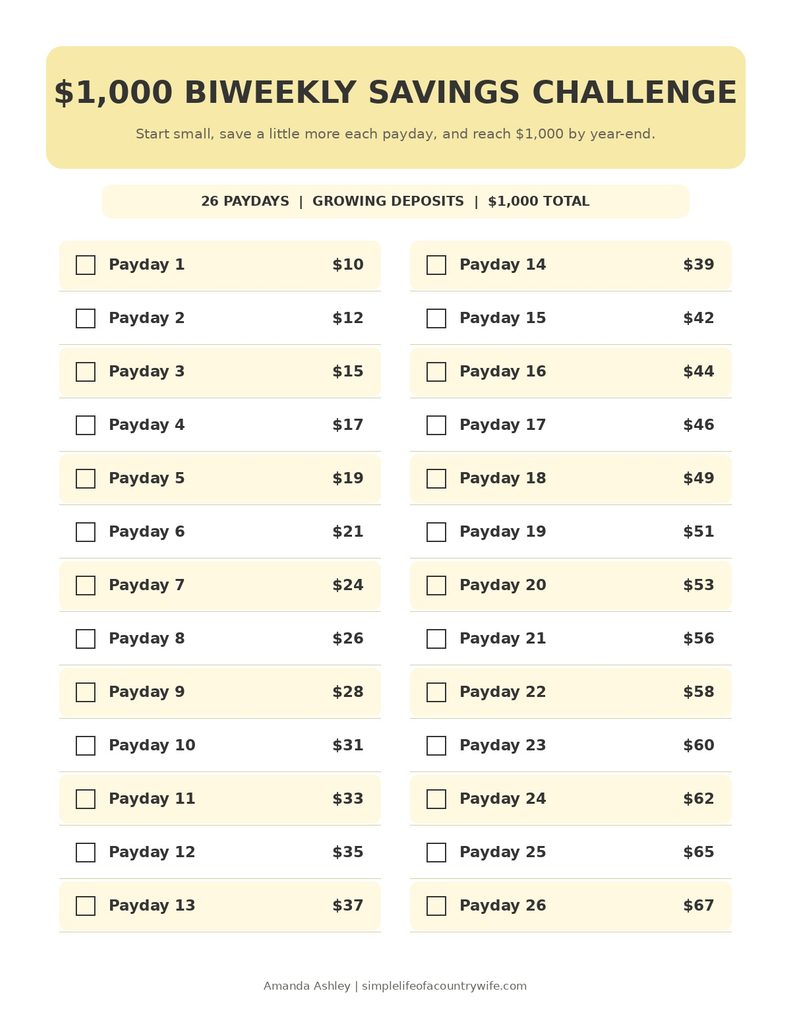
Print it out, stick it on the fridge, or keep it in your budget binder. Either way, check off each payday as you go. There’s something satisfying about physically marking off a box that a spreadsheet just doesn’t give you.
One thing worth knowing before you start: the amounts grow a little each payday, and the very last one jumps up more than the rest so the total lands exactly on $1,000. That’s on purpose. It works well as a final push near the end of the year, and if $75 feels like too much in one shot, you can always split it across your last two paychecks instead.
A few ways to make it easier
Automate it. Set up a transfer to a separate savings account that lands the same day as your paycheck, so the money moves before you get a chance to spend it.
Flip it if your income is irregular. If some paychecks are bigger than others (think tips, commission, or freelance work), match the bigger deposit amounts to your bigger paychecks instead of following the chart in order.
Don’t restart if you miss one. If a payday slips by, just pick up on the next one. Missing a single deposit doesn’t mean the whole thing falls apart, it just means your total lands a little under $1,000, which is still real progress.
Round up if it’s easier. If $13 feels like an odd number to transfer, round up to $15 and finish early. There’s no rule that says you can’t beat your own chart.
What $1,000 actually does
A thousand dollars won’t fix everything, but it covers a lot of the stuff that used to go on a credit card: a car repair, a vet visit, a broken appliance. Having that money already sitting there instead of scrambling to find it is the whole point of this challenge.
If you’re getting paid every two weeks anyway, you might as well have a savings plan that matches.